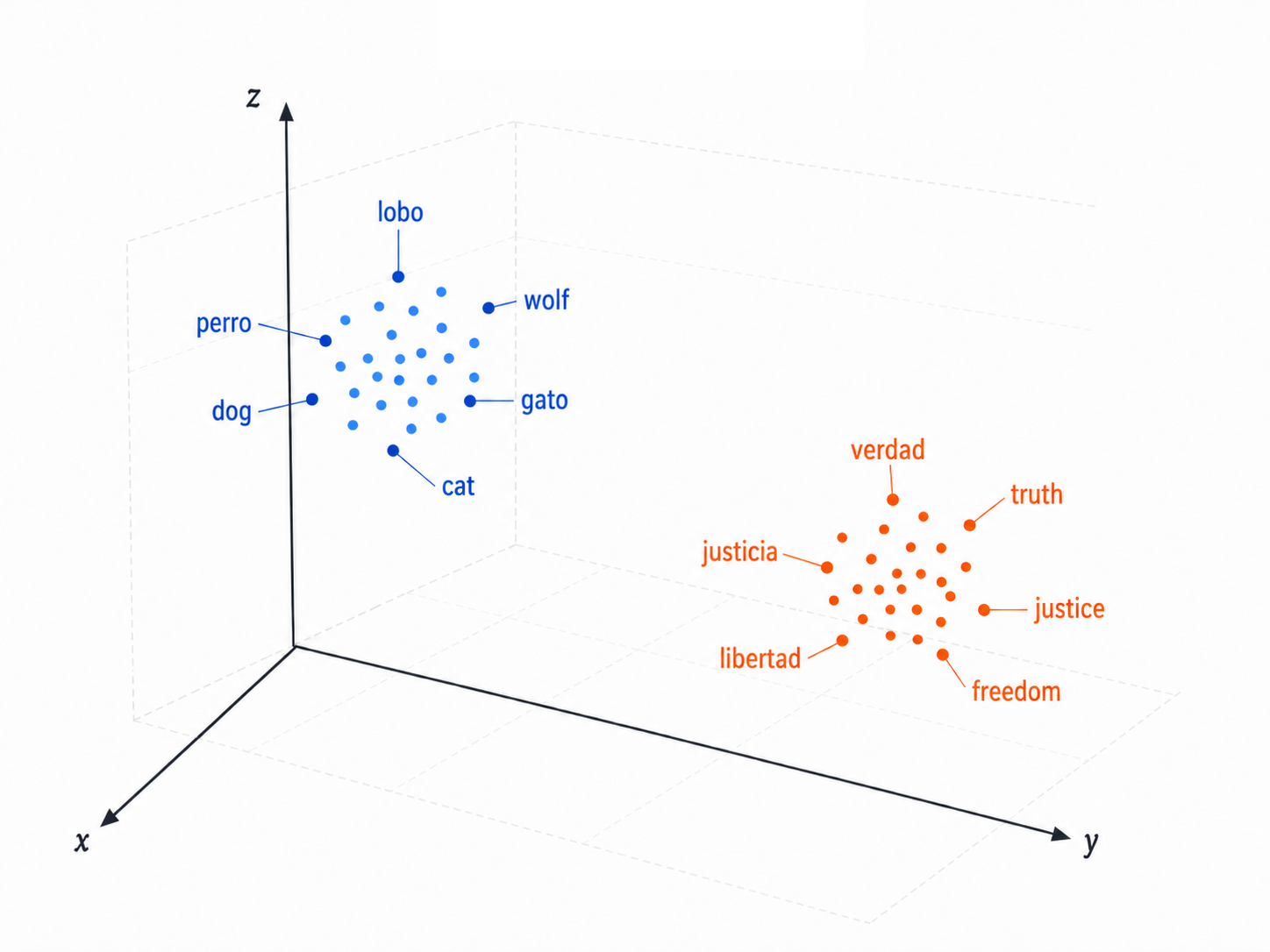
A study in Cell suggests that the bilingual brain does not translate word by word, but organizes languages as maps of meaning in a way surprisingly similar to AI models.#
The finding suggests that the bilingual brain does not translate from one language to another like a dictionary would. It uses something more like a shared map of meanings: each language enters through a different door, but both access the same conceptual space. That idea connects naturally with multilingual language models, which also represent words and ideas as positions within a semantic space.
When a bilingual person hears “dog” and then “perro,” their brain knows that both words point to the same thing.
The question is: how does it do that? The most intuitive explanation is that we have a kind of internal dictionary — a mental table where “dog = perro,” “house = casa,” “water = agua.” According to that idea, some neurons would act as bridges between the two languages, firing for both a word and its translation.
But a study published in Cell in 2026 tested that idea directly by looking at the activity of individual neurons in bilingual people. And what it found was more interesting: the brain does not seem to translate word by word. Rather, it organizes meanings in a shared map that each language accesses through different routes.
What they did
Xinyuan Yan and her colleagues recorded the activity of individual hippocampal neurons in four people bilingual in English and Spanish. Participants listened to texts in both languages, read sentences aloud, and held spontaneous conversations while the researchers observed how their neurons responded.
What makes the study unusual is its level of detail: it analyzes language neuron by neuron, in people who were using two languages both when listening and when speaking.
They found some neurons that responded in a similar way to equivalent words — such as “earth” and “tierra” — but there were few of them. Most did not act like an internal dictionary. That suggests that the bilingual brain does not translate word by word, but connects both languages through a broader organization of meaning.
What is shared is the geometry
When the researchers built semantic maps from neural activation patterns, they found that the geometry of those maps was preserved across languages. If “dog” and “wolf” are close in English because they share semantic territory — animals, nature, danger, instinct — then “perro” and “lobo” maintain a similar relationship in Spanish.
What matters is not that each word activates exactly the same neurons in both languages. What matters is that the distances between concepts are preserved.
The paper describes this as a kind of shared coordinate system, read from different angles. English and Spanish would access the same semantic geometry, but through different readout axes.
Imagine a three-dimensional sculpture. Two people looking at it from different positions see different profiles, but they are looking at the same object. The brain may be doing something structurally similar when it processes the same concept in two languages.
Something similar happens in AI models
The researchers compared what they observed in the brain with mBERT, an AI model trained on many languages. These models do not store words like a dictionary — “dog = perro” — but as vectors: coordinates inside a space of meanings.
In that space, related words sit close together: dog, wolf, animal, pet. Distant words, such as fork or tax, fall in other regions.
What is interesting is that the bilingual brain seems to solve the problem in a similar way. It does not connect two languages word by word, but organizes meanings in a shared map. Each language has its own routes, but both arrive at similar zones of meaning.
If the bilingual brain works with maps of meaning, perhaps many traditional ways of teaching languages fall short. Learning a language is not just translating words: it is connecting sounds, phrases, and structures with scenes, actions, emotions, and contexts. Perhaps that is why purely “blackboard-based” learning feels so limited. The blackboard organizes, explains, and classifies, but it rarely creates real linguistic experience. Language is better learned when it stops being a table of correspondences and starts functioning as what it really is: a way of moving through the world.
What the study ultimately suggests is that neither the brain nor language models need a dictionary to handle meaning. Both have arrived, through very different paths, at a similar solution: representing the world as a space of relationships, where words are not labels but coordinates. Perhaps that is not a coincidence.
Source Yan X, Chavez AG, Franch M et al. “Shared neural geometries for bilingual semantic representations in human hippocampal neurons.” Cell 189, 1–16 (2026). https://doi.org/10.1016/j.cell.2026.05.020